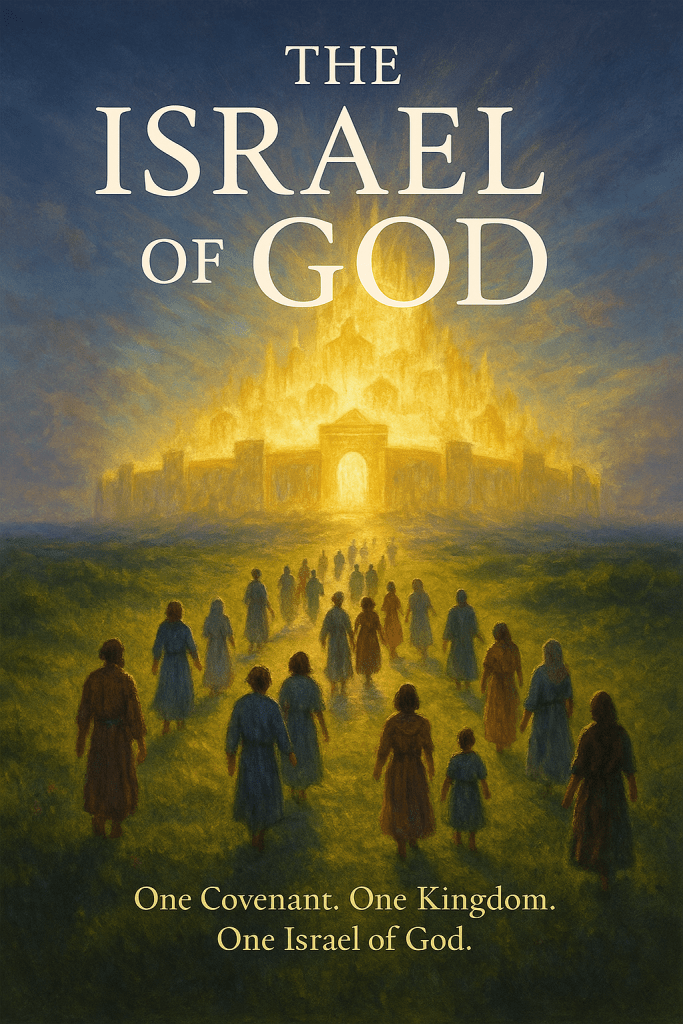
The Church as New Covenant Israel: The Fulfillment and Continuation of God’s Covenant People
Preface to the Reader
For many years I believed that standing with the modern state of Israel was a biblical duty. Like many Christians, I associated political support with faithfulness to God’s promises. That conviction changed only after I studied Scripture more deeply and later visited the region myself. What I saw and learned forced me to distinguish between the nation that bears the ancient name and the people of God as defined by Christ and His covenant.
This work is not written out of hostility toward any people, but out of a desire for honesty before God and His Word. The formation of the modern state, the displacement of families in the 1948 Nakba, and the continued denial of the right of return stand in painful contrast to the justice, mercy, and humility God requires. No nation—ancient or modern—can claim divine favor while rejecting the righteousness revealed in His Son.
My purpose is not political, but theological: to show that God’s promises to Abraham are fulfilled in Christ and His Church. I believe Scripture teaches that the covenant people of God are defined by faith, not by ethnicity or borders, and that the peace we seek for the Holy Land will come only through the Prince of Peace Himself.
If these pages challenge long-held assumptions, I ask only that they be read with the same sincerity and openness with which they were written. May the Spirit who leads into all truth guide every reader to see more clearly the unity of God’s redemptive plan in Christ.
Author’s Note
The early Church, both East and West, affirmed that Christ is the fulfillment of Israel’s hope. This study builds on that foundation through a Protestant lens, emphasizing the continuity of God’s covenant people.
The chapters that follow trace that covenant story from Abraham to Christ, from the prophets to the apostles, from the shadow of the old temple to the light of the Church—the true Israel of God. My hope is that readers will see in these pages the beauty and coherence of Scripture’s single redemptive thread, woven by the hand of God through history and fulfilled in His Son.
Part 1 — Introduction and Overview
For nearly two thousand years, the Christian Church has proclaimed that it is not a replacement for Israel, but the continuation and fulfillment of Israel under the New Covenant. The early Church, composed almost entirely of ethnic Jews, understood itself as the faithful remnant of Israel, reborn through the death and resurrection of the Messiah. As the gospel spread to the nations, Gentiles were grafted into this redeemed people—not by circumcision or bloodline, but by faith and baptism. Thus, the Church stands as spiritual Israel, true Israel, and the Israel of God (Galatians 6:16).
This restoration is vividly prefigured in the story of Israel’s divided kingdom. The ten northern tribes—scattered among the nations and stripped of their identity—become the prophetic picture of humanity estranged from God yet destined to be restored through the Messiah. In Christ, their return is realized: the dispersed are gathered, the nations are grafted in, and Israel is made whole again as the Church.
When we first read the Bible, it can feel like a collection of disconnected stories. We don’t yet know the plot, so we pass over the clues. But once we understand the story—the covenant story of God’s redemption through Israel fulfilled in Christ—we begin to see those clues everywhere. The promises, the patterns, the prophecies all weave together into one continuous revelation of God’s purpose: to form one covenant people in His Son.
From the call of Abraham to the revelation of Christ, God’s purpose has always been to form one covenant family. Scripture never teaches two peoples of God, two covenants, or two redemptive plans. Rather, God promised Abraham that through his seed “all nations of the earth shall be blessed” (Genesis 22:18). That seed, Paul says, is Christ:
“Now to Abraham and his Seed were the promises made. He does not say, ‘And to seeds,’ as of many, but as of one, ‘And to your Seed,’ who is Christ.”
— Galatians 3:16, NKJV
Through Christ, the covenant expands beyond ethnic borders to include all who believe. Paul continues,
“For you are all sons of God through faith in Christ Jesus… and if you are Christ’s, then you are Abraham’s seed, and heirs according to the promise.”
— Galatians 3:26–29
This is not replacement theology, but fulfillment theology. The Church did not replace Israel—it is Israel, renewed and restored under the New Covenant. The promises made to Abraham, Isaac, and Jacob are not nullified, but realized in the Messiah and extended to all nations.
The term Jew historically referred only to those from Judah, the southern kingdom that remained after the ten northern tribes of Israel were taken into captivity. Yet God’s covenant was with all twelve tribes, not Judah alone. When the northern tribes were scattered and assimilated among the nations, they lost their identity—but God never lost sight of them. He promised through the prophets that He would one day regather and reunite all Israel under one Shepherd. That promise is fulfilled in Christ, who declared,
“Other sheep I have which are not of this fold; them also I must bring, and they will hear My voice; and there will be one flock and one shepherd.”
— John 10:16
In Him, Judah and Israel, Jew and Gentile, are gathered into one spiritual nation—the true covenant people of God. The apostles proclaim this mystery revealed:
“That the Gentiles should be fellow heirs, of the same body, and partakers of His promise in Christ through the gospel.”
— Ephesians 3:6
Thus, the Church is not a “parenthesis” in God’s plan, as dispensationalism falsely claims, but the very realization of His eternal purpose—the Israel of God, born not of the flesh but of the Spirit.
In this essay, we will trace the biblical and historical evidence for this truth. We will see that:
- The Old Covenant, established at Sinai, was temporary and has passed away.
- Jesus Christ fulfilled Israel’s story and now embodies her identity.
- The kingdom was taken from unbelieving Israel and given to a people bearing fruit—the Church.
- Gentiles are grafted into Israel’s olive tree through faith, not placed on a separate track.
- The scattered tribes are restored in Christ, as foretold by the prophets.
- The Church is the true continuation of Israel, not a replacement but a rebirth.
God’s purpose from the beginning was to create one people in Christ, redeemed by grace, sealed by the Spirit, and destined to inherit the everlasting kingdom. As Paul wrote:
“For they are not all Israel who are of Israel… that is, those who are the children of the flesh, these are not the children of God; but the children of the promise are counted as the seed.”
— Romans 9:6–8
The following sections will demonstrate how this plan unfolded—from Abraham to Christ, from the prophets to the apostles, from the shadow of the Old Covenant to the light of the New.
Part 2 — The Story of Israel: From Abraham to the Exile and Prophetic Hope
The story of Israel begins with God’s call to Abraham, a man set apart from the nations to become the father of faith. Through him, God established a covenant that would ultimately embrace the whole world.
Abraham: The Father of Faith
God’s covenant with Abraham is the foundation of all subsequent revelation. In Genesis 12:1–3, the Lord said:
“Get out of your country, from your family and from your father’s house, to a land that I will show you.
I will make you a great nation; I will bless you and make your name great; and you shall be a blessing.
I will bless those who bless you, and I will curse him who curses you; and in you all the families of the earth shall be blessed.”
This was not merely a promise of territory, but of transformation—a call to become a covenant people through whom divine blessing would flow to all families of the earth. Abraham’s faith, not his bloodline, became the model of covenant righteousness:
“And he believed in the Lord, and He accounted it to him for righteousness.”
— Genesis 15:6
Through Abraham, God established a pattern of justification by faith that would later be fulfilled in Christ. The promise was reiterated in Genesis 17:7–8:
“And I will establish My covenant between Me and you and your descendants after you in their generations, for an everlasting covenant, to be God to you and your descendants after you.
Also I give to you and your descendants after you the land in which you are a stranger, all the land of Canaan, as an everlasting possession; and I will be their God.”
Yet as Hebrews later explains, even Abraham understood that this earthly land was but a shadow of a greater inheritance:
“For he waited for the city which has foundations, whose builder and maker is God.”
— Hebrews 11:10
Thus, the promise was never limited to soil or borders, but to a spiritual reality—the kingdom of God, which Christ would later inaugurate.
Isaac and Jacob: The Covenant Line Continues
Abraham’s son Isaac was born miraculously, a child of promise rather than natural striving. God reaffirmed His word:
“I will perform the oath which I swore to Abraham your father. And I will make your descendants multiply as the stars of heaven; I will give to your descendants all these lands; and in your seed all the nations of the earth shall be blessed.”
— Genesis 26:3–4
Isaac’s son Jacob received the covenant blessing instead of Esau, not by human merit but divine choice. After wrestling with God, Jacob’s name was changed to Israel:
“Your name shall no longer be called Jacob, but Israel; for you have struggled with God and with men, and have prevailed.”
— Genesis 32:28
From Jacob came twelve sons—Reuben, Simeon, Levi, Judah, Dan, Naphtali, Gad, Asher, Issachar, Zebulun, Joseph, and Benjamin—the patriarchs of the twelve tribes of Israel. From them would emerge a nation chosen to carry the covenant forward.
From Egypt to Sinai: The Birth of a Nation
Through Joseph, Israel was preserved from famine, settling in Egypt where they grew into a great multitude. Four centuries later, under Moses, God delivered them from bondage, fulfilling His word to Abraham (Genesis 15:13–14). At Mount Sinai, He established a covenant with the people:
“Now therefore, if you will indeed obey My voice and keep My covenant, then you shall be a special treasure to Me above all people; for all the earth is Mine.
And you shall be to Me a kingdom of priests and a holy nation.”
— Exodus 19:5–6
This Mosaic Covenant was conditional and temporary—a tutor to lead Israel to Christ (Galatians 3:24). It was marked by external law, sacrifices, and priesthood, all pointing forward to the New Covenant. Yet even then, God desired heart obedience, not mere ritual:
“Oh, that they had such a heart in them that they would fear Me and always keep all My commandments.”
— Deuteronomy 5:29
The Old Covenant revealed God’s holiness but could not impart the power to obey. It exposed sin but could not remove it. Its sacrifices were shadows of the Lamb to come.
The Kingdom of Israel: Rise and Division
Under Joshua, Israel entered the Promised Land, but faithlessness persisted. The era of the judges was marked by cycles of rebellion and restoration. Finally, under David, Israel became a united kingdom and received the Messianic promise:
“Your house and your kingdom shall be established forever before you. Your throne shall be established forever.”
— 2 Samuel 7:16
David’s line pointed forward to the true Son of David—the Messiah, whose reign would never end (Luke 1:32–33).
After Solomon’s reign, the kingdom split:
- The southern kingdom (Judah), consisting of Judah and Benjamin, centered in Jerusalem.
- The northern kingdom (Israel), consisting of ten tribes, centered in Samaria.
As Moses had forewarned, covenant disobedience would lead to exile and dispersion.
“Then the Lord will scatter you among all peoples, from one end of the earth to the other; and there you shall serve other gods, which neither you nor your fathers have known—wood and stone.”
— Deuteronomy 28:64 (NKJV)
History unfolded exactly as Moses prophesied. The northern tribes were taken into Assyrian captivity, intermarried, and were lost among the nations. Judah later fell to Babylon, and the people were scattered again. Yet even in judgment, God preserved a remnant and promised restoration—a gathering that would one day come through the Messiah and a New Covenant written on their hearts.
The northern kingdom fell into idolatry and injustice. Despite prophetic warnings, it was conquered by Assyria in 722 B.C.:
“In the ninth year of Hoshea, the king of Assyria took Samaria and carried Israel away to Assyria.”
— 2 Kings 17:6
Many were killed or exiled; others intermarried and were assimilated. Their national identity dissolved, but not their place in God’s eternal purpose.
The Scattering and the Lost Tribes
The prophets described this dispersion as both judgment and preparation. Through Amos, God declared:
“For surely I will command, and will sift the house of Israel among all nations, as grain is sifted in a sieve; yet not the smallest grain shall fall to the ground.”
— Amos 9:9
Though scattered, none would be forgotten. Hosea symbolically named his children Lo-Ruhamah (“No Mercy”) and Lo-Ammi (“Not My People”), yet promised hope:
“In the place where it was said to them, ‘You are not My people,’ there it shall be said to them, ‘You are sons of the living God.’”
— Hosea 1:10
This prophecy pointed forward to the inclusion of the Gentiles—and the restoration of the lost tribes—in Christ.
Prophetic Hope of Restoration
The prophets foresaw a future reunion and renewal under a single Shepherd:
“He will set up a banner for the nations, and will assemble the outcasts of Israel, and gather together the dispersed of Judah from the four corners of the earth.”
— Isaiah 11:12
“Behold, the days are coming, says the Lord, when I will make a new covenant with the house of Israel and with the house of Judah.”
— Jeremiah 31:31
“Surely I will take the stick of Joseph… and the tribes of Israel, his companions; and I will join them with the stick of Judah… and they will become one stick in My hand.”
— Ezekiel 37:19
Ezekiel’s vision of two sticks symbolized the reunification of all Israel under one King—the Messiah. This hope was not ethnic or political but spiritual, fulfilled in Christ and His Church.
The stage was thus set: the Old Covenant exposed sin; the prophets promised a New Covenant; Israel’s scattering prepared for a universal ingathering. The Redeemer would come not merely to restore one nation, but to fulfill God’s promise to Abraham—that in his Seed, all nations of the earth would be blessed.
The prophets saw more than a political reunion; they foresaw the spiritual resurrection of Israel itself. The lost tribes, symbolizing the nations, would find their home again in the covenant through the coming Messiah. This is the restoration the New Testament proclaims — not a return to borders and bloodlines, but to faith and fellowship in Christ.
Part 3 — Fulfillment in Christ: Israel’s True Seed and the Establishment of the New Covenant
All of Israel’s history—its promises, covenants, priesthood, sacrifices, and prophetic hopes—pointed forward to one person: Jesus Christ, the true Seed of Abraham, the Son of David, and the embodiment of faithful Israel. In Him, the law is fulfilled, the covenants find completion, and the promises are inherited by all who believe.
Christ: The True Seed of Abraham
Paul unveils this mystery plainly in his letter to the Galatians:
“Now to Abraham and his Seed were the promises made. He does not say, ‘And to seeds,’ as of many, but as of one, ‘And to your Seed,’ who is Christ.”
— Galatians 3:16
Jesus is the promised Seed through whom every nation is blessed. This means that the covenant promise to Abraham was always Christ-centered, not race-centered. Those united to Him by faith, whether Jew or Gentile, are counted as Abraham’s offspring and heirs of the promise:
“If you are Christ’s, then you are Abraham’s seed, and heirs according to the promise.”
— Galatians 3:29
Thus, covenant membership no longer depends on lineage, circumcision, or the keeping of Mosaic law, but on faith in Christ—the true Israelite who perfectly obeyed God’s will.
Christ: The Fulfillment of the Law and Prophets
Jesus declared this explicitly:
“Do not think that I came to destroy the Law or the Prophets. I did not come to destroy but to fulfill.”
— Matthew 5:17
The Law and the Prophets were never ends in themselves but shadows pointing to the reality of Christ. Every sacrifice, feast, and priestly ordinance anticipated His atoning work. The writer of Hebrews explains:
“For the law, having a shadow of the good things to come, and not the very image of the things, can never with these same sacrifices… make those who approach perfect.”
— Hebrews 10:1
“For it is not possible that the blood of bulls and goats could take away sins.”
— Hebrews 10:4
Christ alone fulfills what the Law could only foreshadow:
“By that will we have been sanctified through the offering of the body of Jesus Christ once for all.”
— Hebrews 10:10
When Jesus cried out on the cross, “It is finished” (John 19:30), He was declaring that the entire redemptive plan foreshadowed by Israel’s history had reached its consummation in Him.
The New Covenant Established
The prophets had long foretold a New Covenant, unlike the one made at Sinai. Jeremiah proclaimed:
“Behold, the days are coming, says the Lord, when I will make a new covenant with the house of Israel and with the house of Judah—
not according to the covenant that I made with their fathers… My covenant which they broke… But this is the covenant that I will make… I will put My law in their minds, and write it on their hearts; and I will be their God, and they shall be My people.”
— Jeremiah 31:31–33
This promise was fulfilled by Christ Himself. On the night He was betrayed, He took the cup and said:
“This cup is the new covenant in My blood, which is shed for you.”
— Luke 22:20
Through His death and resurrection, Christ inaugurated a covenant that grants forgiveness, imparts the Holy Spirit, and writes God’s law on human hearts. The Old Covenant, with its temple, priesthood, and sacrifices, became obsolete:
“In that He says, ‘A new covenant,’ He has made the first obsolete. Now what is becoming obsolete and growing old is ready to vanish away.”
— Hebrews 8:13
When the temple in Jerusalem was destroyed in A.D. 70, it was a visible sign that the Old Covenant order had passed away forever. There was no more altar, priesthood, or animal sacrifice because the true Temple, Priest, and Sacrifice—Christ Himself—had come.
Historical Confirmation: The Fall of Jerusalem
The end of the Old Covenant was not only spiritual but historical. Jesus had warned, “Do you see these great buildings? Not one stone shall be left upon another, that shall not be thrown down” (Mark 13:2).
In A.D. 70 this prophecy came to pass. The Jewish historian Flavius Josephus, an eyewitness to the Roman siege, recorded the city’s devastation and the burning of the Temple in The Jewish War. He describes how the sanctuary “was set on fire… and the flames surrounded the altar,” and that the slaughter was so great that “the number of those who perished exceeded all that had ever been heard of” (Wars 6.4.5–6).
Josephus also reports several extraordinary signs that preceded the destruction. In Wars 6.5.3 he writes that chariots and armed troops were seen “running in the clouds and surrounding cities,” and that on the eve of Pentecost a mysterious voice was heard in the Temple saying, “Let us leave this place.” Many early Christian writers understood this as the departure of God’s presence from the old sanctuary, just as Ezekiel had seen the glory depart from the first temple before its fall (Ezekiel 10–11).
With the Temple destroyed, the priesthood ended and sacrifices ceased—exactly as the book of Hebrews declares: “In that He says, ‘A new covenant,’ He has made the first obsolete” (Hebrews 8:13). The visible judgment on Jerusalem confirmed what Christ accomplished at Calvary: the old covenant order had truly passed away, and the New Covenant community—the Church—now stood as the dwelling place of God’s Spirit.
Christ: The True Israel and Faithful Son
In the Gospels, Jesus reenacts the story of Israel: He comes out of Egypt (Matthew 2:15), passes through the waters of baptism as Israel passed through the Red Sea, and spends forty days in the wilderness mirroring Israel’s forty years of testing. Where Israel failed, Christ triumphed.
Hosea had written, “Out of Egypt I called My son” (Hosea 11:1), referring first to the nation of Israel. Matthew applies it directly to Jesus, showing that He embodies the role of God’s Son in perfection. Christ is thus the true Israel, fulfilling in His person all that the nation prefigured.
He is also the true Temple. When the Jews demanded a sign, Jesus answered:
“Destroy this temple, and in three days I will raise it up.”
— John 2:19
John explains, “He was speaking of the temple of His body.” The temple where God dwelled among men now finds its fulfillment in the incarnate Christ—and through Him, in the Church, His body. Now, therefore, you are no longer strangers and foreigners, but fellow citizens with the saints and members of the household of God. (Ephesians 2:19–22).
The Kingdom Inaugurated
Many in Israel expected a political restoration, but Christ revealed a spiritual kingdom. He told Pilate:
“My kingdom is not of this world.”
— John 18:36
The kingdom of God is not postponed to a future age; it began with Christ’s first coming:
“The kingdom of God is within you.”
— Luke 17:21
Believers are already citizens of this kingdom:
“He has delivered us from the power of darkness and conveyed us into the kingdom of the Son of His love.”
— Colossians 1:13
It is a kingdom that grows not through conquest but through conversion, not by borders but by belief. It encompasses all nations and will one day fill the earth.
Christ: The Fulfillment of Every Promise
Paul summarizes the grand conclusion of redemptive history:
“For all the promises of God in Him are Yes, and in Him Amen, to the glory of God through us.”
— 2 Corinthians 1:20
Every promise of restoration, every covenant blessing, every prophetic hope finds its fulfillment in Christ. He is the true Seed, the true King, the true Priest, and the true Sacrifice. Through Him, the covenant blessings promised to Israel now flow to the nations.
In this way, Christ fulfills and transcends the Old Covenant, transforming it into a universal and eternal reality. The Church, His body, inherits the covenant promises not by replacing Israel, but by being joined to the faithful remnant that believed in Him.
This is the mystery of the gospel: in Christ, the entire story of Israel—its exodus, exile, and hope—is brought to completion and expanded to include all who believe. The next section will show how this fulfillment extends to the Church, which is now the living expression of New Covenant Israel.
Part 4 — The Church as New Covenant Israel: Jew and Gentile United as One People of God
If Christ is the fulfillment of Israel’s story, then His body—the Church—is the continuation of Israel’s mission. The New Testament reveals that those who are united to Christ by faith are the true heirs of the covenant promises. The Church is not a new entity detached from Israel’s history, but the restored and spiritual Israel through which God’s redemptive plan is carried forward to the ends of the earth.
One New Man in Christ
Paul explains this profound mystery in Ephesians 2:11–22, where he addresses Gentile believers:
“Therefore remember that you, once Gentiles in the flesh—who are called Uncircumcision by what is called the Circumcision made in the flesh by hands that at that time you were without Christ, being aliens from the commonwealth of Israel and strangers from the covenants of promise, having no hope and without God in the world.
But now in Christ Jesus you who once were far off have been brought near by the blood of Christ.
For He Himself is our peace, who has made both one, and has broken down the middle wall of separation, having abolished in His flesh the enmity, that is, the law of commandments contained in ordinances, so as to create in Himself one new man from the two, thus making peace, and that He might reconcile them both to God in one body through the cross, thereby putting to death the enmity.”
Here Paul declares that Jew and Gentile, once divided by law and lineage, are now reconciled through the cross into one new humanity—one body, one household, one temple. This unity is not merely spiritual symbolism; it is the very essence of the New Covenant.
“Now, therefore, you are no longer strangers and foreigners, but fellow citizens with the saints and members of the household of God, having been built on the foundation of the apostles and prophets, Jesus Christ Himself being the chief cornerstone, in whom the whole building, being fitted together, grows into a holy temple in the Lord, in whom you also are being built together for a dwelling place of God in the Spirit.”
— Ephesians 2:19–22
This passage shatters the dispensational claim that Israel and the Church are two distinct peoples. There is now one redeemed community—spiritual Israel—built upon Christ, the cornerstone.
The Olive Tree of God
Paul expands this imagery in Romans 11, describing God’s people as one olive tree. Some natural branches (unbelieving Jews) were broken off, while wild olive branches (believing Gentiles) were grafted in. Yet the tree itself—Israel—remains one:
“And if some of the branches were broken off, and you, being a wild olive tree, were grafted in among them, and with them became a partaker of the root and fatness of the olive tree, do not boast against the branches.”
— Romans 11:17–18
The Gentiles do not form a new tree; they are grafted into the existing one. The “root” is the covenant promises made to Abraham, now fulfilled in Christ. The unity of God’s people is organic and continuous. Paul warns the Gentiles:
“Do not be haughty, but fear. For if God did not spare the natural branches, He may not spare you either.”
— Romans 11:20–21
The true Church, then, consists of believing Jews and Gentiles, both nourished by the same covenant root—faith in the Redeemer. There has never been two trees, two peoples, or two plans.
The True Circumcision
Under the Old Covenant, physical circumcision marked membership in Israel. Under the New, it is a matter of the heart:
“For he is not a Jew who is one outwardly, nor is circumcision that which is outward in the flesh; but he is a Jew who is one inwardly; and circumcision is that of the heart, in the Spirit, not in the letter; whose praise is not from men but from God.”
— Romans 2:28–29
Paul reiterates this in Philippians 3:3:
“For we are the circumcision, who worship God in the Spirit, rejoice in Christ Jesus, and have no confidence in the flesh.”
The Church, therefore, is the circumcised Israel of the Spirit—those whose hearts are sealed by the Holy Spirit, not by external rites.
The Kingdom Taken and Given
Jesus Himself declared that covenant privilege was not guaranteed by ethnic descent. To the religious leaders of His day, He said:
“Therefore I say to you, the kingdom of God will be taken from you and given to a nation bearing the fruits of it.”
— Matthew 21:43
This “nation” is not a political state but the holy nation described by Peter:
“But you are a chosen generation, a royal priesthood, a holy nation, His own special people, that you may proclaim the praises of Him who called you out of darkness into His marvelous light; who once were not a people but are now the people of God, who had not obtained mercy but now have obtained mercy.”
— 1 Peter 2:9–10
Peter here echoes Hosea’s prophecy (Hosea 1:10), applying it to the Church—Jew and Gentile believers alike. The once “not My people” are now the chosen people of God. The “holy nation” that inherits the kingdom is not ethnic Israel, but the Church—the New Covenant Israel.
One Flock, One Shepherd
Jesus prophesied this union long before the Church was formed:
“And other sheep I have which are not of this fold; them also I must bring, and they will hear My voice; and there will be one flock and one shepherd.”
— John 10:16
In Christ’s single flock, the lost sheep of Israel and the Gentiles are gathered together under one Shepherd. This fulfills Ezekiel’s vision:
“Then I will make them one nation in the land… and one king shall be king over them all.”
— Ezekiel 37:22
The King is Christ, reigning over His unified, spiritual kingdom.
Believers as God’s Temple
Under the New Covenant, the temple is no longer a building of stone, but the redeemed community indwelt by God’s Spirit:
“Do you not know that you are the temple of God and that the Spirit of God dwells in you?”
— 1 Corinthians 3:16
“You also, as living stones, are being built up a spiritual house, a holy priesthood, to offer up spiritual sacrifices acceptable to God through Jesus Christ.”
— 1 Peter 2:5
The destruction of the Jerusalem temple in A.D. 70 signified not the end of God’s dwelling, but its expansion. God’s presence now fills the entire Church, the body of Christ—a temple made of living stones from every tribe and nation.
The New Jerusalem
The Church’s destiny is not an earthly kingdom limited to one land, but a heavenly city that encompasses all creation:
“But you have come to Mount Zion and to the city of the living God, the heavenly Jerusalem, to an innumerable company of angels,
to the general assembly and church of the firstborn who are registered in heaven.”
— Hebrews 12:22–23
In Revelation, this New Jerusalem is described not as a geopolitical entity but as the Bride of Christ:
“Then I, John, saw the holy city, New Jerusalem, coming down out of heaven from God, prepared as a bride adorned for her husband.”
— Revelation 21:2
The imagery is unmistakable: the New Jerusalem is the redeemed people of God—the Church in glory, the eternal Israel.
Summary
The New Testament consistently teaches that the Church is the continuation and fulfillment of Israel.
- The Church is the one new man (Ephesians 2).
- The Church is the olive tree (Romans 11).
- The Church is the true circumcision (Philippians 3).
- The Church is the holy nation (1 Peter 2).
- The Church is the temple of God (1 Corinthians 3).
- The Church is the New Jerusalem (Revelation 21).
Every image points to one reality: there is one covenant people of God, unified in Christ, redeemed by grace, and indwelt by the Spirit. The next section will reveal how this unity fulfills the prophetic mystery—how the scattered tribes, lost among the nations, are restored in Christ and how false teachings such as dispensationalism obscure this truth.
Part 5 — The Mystery of Israel’s Restoration: The Ten Tribes Fulfilled in Christ and His Church.
The apostles called it a mystery—something once hidden, now revealed by the Holy Spirit: that God would unite Jew and Gentile, Judah and the scattered tribes, into one covenant body through Christ. This mystery was foretold by the prophets, fulfilled in Jesus, and explained by Paul. Yet in later centuries, it was obscured by man-made systems such as dispensationalism, which divides what God has made one.
A word of grace. Many sincere followers of Christ hold futurist or dispensational views out of a genuine desire to honor Scripture and support God’s work among His people. I honor that zeal and share their longing for the Lord’s return. My purpose here is not to question anyone’s faith, but to invite all of us—myself included—to “test all things; hold fast what is good” (1 Thess 5:21) and to search the Scriptures together with open hearts.
The Mystery: “All Israel Will Be Saved”
Paul speaks directly to this divine secret in Romans 11:25–27:
“For I do not desire, brethren, that you should be ignorant of this mystery, lest you should be wise in your own opinion, that blindness in part has happened to Israel until the fullness of the Gentiles has come in. And so all Israel will be saved, as it is written: ‘The Deliverer will come out of Zion, And He will turn away ungodliness from Jacob; For this is My covenant with them, When I take away their sins.’”
“All Israel” here does not refer to a future ethnic nation or a geopolitical state. It refers to the total covenant people of God—the faithful remnant of Judah who believed in Christ, the scattered tribes rediscovered through the gospel, and the Gentiles who are adopted into Abraham’s family by faith. This threefold unity forms the redeemed Israel of God.
Paul explains earlier in Romans 9:6–8:
“For they are not all Israel who are of Israel, nor are they all children because they are the seed of Abraham; but, ‘In Isaac your seed shall be called.’ That is, those who are the children of the flesh, these are not the children of God; but the children of the promise are counted as the seed.”
The physical descendants of Abraham are not automatically heirs of the promise; the true seed consists of those who believe in Christ. The branches of unbelief—such as the Pharisees and religious leaders who rejected Jesus—were cut off. Yet Paul also assures us that they may be grafted back in through faith:
“And they also, if they do not continue in unbelief, will be grafted in, for God is able to graft them in again.”
— Romans 11:23
This is the fullness of the mystery: God restores His covenant people through Christ. The ten northern tribes, long scattered among the nations, are gathered not by genealogy or DNA, but by the gospel. The descendants of those lost tribes may be scattered across every continent today—unknown to themselves, but known to God. When they believe in Christ, they are spiritually regrafted into the covenant tree alongside believing Jews and Gentiles.
This fulfills Hosea’s prophecy:
“Then I will say to those who were not My people, ‘You are My people!’ And they shall say, ‘You are my God!’”
— Hosea 2:23
And Peter applies it to the Church:
“Who once were not a people but are now the people of God, who had not obtained mercy but now have obtained mercy.”
— 1 Peter 2:10
The Church, therefore, is the restoration of Israel—the fulfillment of all prophetic expectation.
The Lost Tribes and the Mystery of Restoration
The ten northern tribes, carried away by Assyria, disappeared from history’s record but never from God’s memory. Scattered among the nations, they became as Gentiles to the world. Yet through the gospel, their descendants—unknown to themselves but known to God—are being restored. When Gentiles believe in Christ, they are not foreign additions; they are the regathering of Israel’s lost multitudes, fulfilling Hosea 1:10: “In the place where it was said to them, ‘You are not My people,’ there it shall be said to them, ‘You are sons of the living God.’”
This is the hidden wisdom Paul called “the mystery”—that the fullness of the Gentiles is, in fact, the fullness of scattered Israel returning through faith in Christ. The promise of reunion given through Ezekiel’s two sticks (Ezek. 37) and Hosea’s “not-My-people” is accomplished in the Church, where Judah’s remnant, Israel’s dispersed, and the Gentile nations are gathered into one redeemed body.
In this way, all Israel is being saved—not through tribal recovery or genetic tracing, but through spiritual rebirth in the Messiah. Every believer, whether of Judah, Ephraim, or the nations, finds identity and inheritance in the same covenant grace.
How Dispensationalism Distorts the Mystery
This unified vision of God’s people was accepted by virtually all Christian theologians for eighteen centuries. The early Church Fathers—Justin Martyr, Irenaeus, Augustine, and others—consistently taught that the Church is the continuation of Israel. Justin wrote to the Jew Trypho, “We are the true, spiritual Israel.” Irenaeus called the Church “the heirs of the covenant.” Augustine declared, “The Church is the true Israel.”
But in the 1800s, a new teaching arose in England through John Nelson Darby, founder of the Plymouth Brethren. Darby introduced a radical distinction between “Israel” and “the Church,” claiming they were two separate peoples with different covenants and destinies. His system—Dispensationalism—was later popularized in America through the Scofield Reference Bible (1909).
For the first time in church history, believers were taught that God had two plans:
- One earthly plan for national Israel,
- And another heavenly plan for the Church.
Scofield’s footnotes—mistakenly treated as inspired commentary—spread this doctrine rapidly, especially through Dallas Theological Seminary (founded 1924 by Lewis Sperry Chafer, Scofield’s disciple) and preachers like J. Frank Norris and W. A. Criswell. By mid-century, this teaching dominated much of American evangelicalism, especially in Texas. Millions of believers began quoting Scofield’s notes as though they were Scripture itself.
Dispensationalism replaced the ancient, unified vision of God’s covenant people with a divided system of two Israels, two kingdoms, and two futures. It turned the Church from the fulfillment of prophecy into a temporary “parenthesis” and re-centered end-times hope on a political state rather than the person of Christ.
The Error Exposed by Scripture
- One People, Not Two.
Paul declares that Gentiles are “fellow heirs, of the same body, and partakers of His promise in Christ through the gospel” (Ephesians 3:6). There is no second body, no second covenant, and no separate destiny. - One Kingdom, Not Postponed.
Jesus said, “The kingdom of God is within you” (Luke 17:21). Paul affirms that God “has conveyed us into the kingdom of the Son of His love” (Colossians 1:13). The kingdom was not postponed until a future millennium; it was inaugurated at the resurrection. - One Covenant, Not Two Tracks.
Hebrews declares the Old Covenant obsolete and replaced by the New (Hebrews 8:13). There is no third covenant for ethnic Israel. All must come through the blood of the Lamb. - One Temple, Not a Rebuilt Shrine.
The New Testament temple is spiritual, composed of living stones (1 Peter 2:5). To expect a future stone temple and renewed sacrifices denies the sufficiency of Christ’s once-for-all atonement (Hebrews 10:10–14). - One Hope, Not Divided Destinies.
There is “one Lord, one faith, one baptism” (Ephesians 4:5). Believers—Jew and Gentile—share the same inheritance: “an inheritance incorruptible and undefiled and that does not fade away” (1 Peter 1:4).
By insisting on a separate destiny for Israel, dispensationalism nullifies the unity that Christ purchased with His own blood. It teaches that the kingdom was delayed, that the Sermon on the Mount belongs to a future age, and that modern geopolitical events fulfill prophecy apart from the gospel. Such ideas divert faith from Christ’s finished work to human politics and national identity.
Pastoral Concerns with Dispensationalism.
This theological error has produced grave moral confusion. Many modern Christians now equate support for a political state with faithfulness to God, forgetting that God’s covenant people are defined not by borders but by belief. The promise to Abraham was not to a parcel of land, but to a people redeemed through his Seed—Christ. To elevate earthly Jerusalem above the heavenly is to return to bondage with Hagar rather than freedom with Sarah (Galatians 4:22–26).
When dispensationalists teach that unbelieving Israel remains “God’s chosen people,” they deny the very heart of the gospel—that no one comes to the Father except through Christ (John 14:6). The New Covenant knows no favoritism:
“For there is no distinction between Jew and Greek, for the same Lord over all is rich to all who call upon Him.”
— Romans 10:12
To affirm that anyone can claim divine covenant status apart from Christ is to reject the cross itself.
Moreover, this distortion has fueled political idolatry. Many professing Christians grant uncritical support to violence and injustice in the Middle East, believing they are defending God’s people. Yet Scripture says:
“Blessed are the peacemakers, for they shall be called sons of God.”
— Matthew 5:9
The true children of God are those who make peace, not those who justify war.
Restoration Through Christ Alone
The prophets foretold a restoration of Israel—but not through military conquest or ethnic revival. The restoration occurs through Christ’s Church. Ezekiel 37 envisioned two sticks, Judah and Ephraim, becoming one in God’s hand—a symbol fulfilled when Jew and Gentile are united in Christ. Hosea 1:10 foretold that those once “not My people” would be called “sons of the living God,” fulfilled when the gospel reached the nations. Amos 9:11–12 prophesied the rebuilding of “David’s fallen tent,” interpreted by James in Acts 15:16–17 as the inclusion of the Gentiles.
Every prophetic promise finds its fulfillment in the Church. The lost tribes are restored, the Gentiles included, and the remnant of Judah preserved—all in the one body of Christ. This is what Paul meant when he wrote, “In this way all Israel will be saved.”
Part 6 — Conclusion: One People, One Covenant, One Kingdom — The Israel of God
This is the climax of God’s redemptive story: the ten tribes once scattered are spiritually regathered, Judah’s remnant is redeemed, and the Gentiles are joined with them in one covenant body — the New Covenant Israel.
From Genesis to Revelation, Scripture reveals one continuous story—the story of God forming, redeeming, and perfecting a single covenant people. The names and outward forms may have changed through history, but the essence has remained the same: a people of faith, chosen by grace, gathered under one King and one covenant.
Through the prophet Isaiah, God foretold that He would bring forth something entirely new—a renewal that would surpass every past deliverance:
“Behold, I will do a new thing,
Now it shall spring forth;
Shall you not know it?
I will even make a road in the wilderness
And rivers in the desert.”
— Isaiah 43:19 (NKJV)
This “new thing” was not simply a return from Babylon but the dawning of the New Covenant itself. The wilderness became the world of scattered Israel and the nations; the rivers are the streams of living water flowing from Christ, the source of new life. In Him, God has indeed done the new thing He promised—making all things new, uniting His people under one Shepherd, and fulfilling every covenant word spoken through the prophets.
The Unity of the Covenant People
In Abraham, the covenant was promised; in Moses, it was shadowed; in Christ, it was fulfilled. The promises given to Abraham, Isaac, Jacob, David, and the prophets converge in the Messiah. All who belong to Him—whether from Judah, the ten tribes, or the Gentile nations—are now part of one household of God.
“Now, therefore, you are no longer strangers and foreigners, but fellow citizens with the saints and members of the household of God.”
— Ephesians 2:19
There are not two peoples of God—one earthly, one heavenly—but one family united in Christ. The kingdom was taken from unbelieving Israel and given to a people bearing its fruits—the Church, the holy nation and royal priesthood.
“But you are a chosen generation, a royal priesthood, a holy nation, His own special people, that you may proclaim the praises of Him who called you out of darkness into His marvelous light.”
— 1 Peter 2:9
This is the “nation” Jesus spoke of in Matthew 21:43, the people who inherit the kingdom not by bloodline but by new birth, not by geography but by grace.
The End of the Old, the Fulfillment of the New
The Old Covenant, bound to the temple, priesthood, and sacrifices, passed away when its purpose was fulfilled. The writer of Hebrews declares it “obsolete” and “ready to vanish away” (Hebrews 8:13). Its priesthood has been replaced by the eternal priesthood of Christ. Its sacrifices have ceased, for the Lamb of God has offered Himself once for all.
“By one offering He has perfected forever those who are being sanctified.”
— Hebrews 10:14
The destruction of Jerusalem and the temple in A.D. 70 signified the definitive end of that covenant system. From the ashes of the old rose the living temple—the body of Christ, the Church, indwelt by the Holy Spirit.
“You also, as living stones, are being built up a spiritual house.”
— 1 Peter 2:5
The Church is therefore not a parenthetical interruption, but the very goal of redemptive history—the New Covenant Israel in which the promises of God are realized.
The True Inheritance
The patriarchs looked beyond Canaan to a heavenly homeland:
“These all died in faith, not having received the promises, but having seen them afar off were assured of them… they desire a better, that is, a heavenly country. Therefore God is not ashamed to be called their God, for He has prepared a city for them.”
— Hebrews 11:13, 16
This inheritance is not a strip of land but the renewed creation itself. Jesus declared, “Blessed are the meek, for they shall inherit the earth” (Matthew 5:5). The Church’s hope is not a political restoration but the consummation of all things when the New Jerusalem descends and God dwells with His people forever.
“Behold, the tabernacle of God is with men, and He will dwell with them, and they shall be His people. God Himself will be with them and be their God.”
— Revelation 21:3
The new creation is the true Promised Land, the eternal inheritance of the Israel of God.
The Israel of God
Paul concludes his letter to the Galatians with a blessing that encapsulates the entire theology of the New Covenant:
“And as many as walk according to this rule, peace and mercy be upon them, and upon the Israel of God.”
— Galatians 6:16
The “Israel of God” is not a separate ethnic group but the whole body of believers—those who walk by the rule of faith in Christ. It includes Jews and Gentiles, the remnant and the restored, the near and the far. In Christ, all barriers have fallen; there is no longer Jew nor Greek, slave nor free, male nor female, but all are one (Galatians 3:28).
The Eternal Covenant and the Everlasting Kingdom
Christ is both King and Covenant. In Him, the covenant is everlasting because the covenant-keeper is eternal. He is the true Son who obeyed where Israel failed, the true David who reigns forever, the true temple where God dwells with man.
“The Lord God will give Him the throne of His father David, and He will reign over the house of Jacob forever, and of His kingdom there will be no end.”
— Luke 1:32–33
The kingdom of God is not postponed but present, growing as the mustard seed into a tree that fills the earth. Its citizens are the redeemed of every nation, tribe, and tongue. Its capital is not Jerusalem below, which is in bondage, but Jerusalem above, which is free (Galatians 4:26).
The Church as the Restoration of Israel
The restoration of Israel promised by the prophets has already begun in Christ and will be completed in the resurrection. Ezekiel’s dry bones live again in the Church, filled with the Spirit. Hosea’s “not My people” have become the people of God. Amos’s fallen tent of David has been rebuilt in the inclusion of the Gentiles. Jeremiah’s New Covenant has been inaugurated in the blood of the Lamb.
Every promise has found its “Yes” in Jesus (2 Corinthians 1:20). The Church is not a replacement for Israel but the resurrection of Israel—the fulfillment, not the forfeiture. In her, the twelve tribes find their reunion, the nations find their blessing, and God finds His dwelling.
The Final Vision
At the end of Scripture, John beholds the consummation of this great plan:
“Now I saw a new heaven and a new earth, for the first heaven and the first earth had passed away… Then I, John, saw the holy city, New Jerusalem, coming down out of heaven from God, prepared as a bride adorned for her husband.”
— Revelation 21:1–2
Here the imagery of Israel, the Church, and the Bride merge into one. The Lamb’s wife is the completed Israel of God—redeemed humanity united forever with its Creator.
The story that began with Abraham ends with the multitude that no one can number, clothed in white robes, from every nation, tribe, and tongue, standing before the throne and before the Lamb (Revelation 7:9–10). That is Israel restored, fulfilled, and glorified.
Final Summary
- The Old Covenant was temporary and has passed away.
- Christ is the fulfillment of Israel—the true Seed, Servant, and King.
- The Church is the continuation of Israel—the New Covenant people of God.
- Gentiles are grafted into Israel’s covenant, not placed on a separate path.
- The lost tribes are restored spiritually through faith in Christ.
- Dispensationalism divides what Scripture unites; the truth is one people under one Shepherd.
- The kingdom is now, and its consummation is eternal.
Therefore, the Church is the New Covenant Israel, the Israel of God, and the true heirs of the promise.
“By which, when you read, you may understand my knowledge in the mystery of Christ… that the Gentiles should be fellow heirs, of the same body, and partakers of His promise in Christ through the gospel.”
— Ephesians 3:4–6
One covenant. One body. One kingdom.
Christ and His Church are the true Israel—God’s Israel—forever!!
Thank you for reading to the end, please keep me in your prayers.
Final Benediction and Prayer:
Dear Heavenly Father, Precious Jesus, and Sweet Holy Spirit,
Thank You for the grace, wisdom, and strength to bring this work to completion. May every paragraph point hearts to Your truth and every word bring glory to Your Name. Let those who read find revelation, peace, and a deeper love for You, the God who keeps covenant and fulfills every promise in Christ.
Bless this labor, Lord, that it might serve the building of Your kingdom and the awakening of Your people to their true identity in You. Guard it from pride, contention, or misuse; let it be a vessel of light and unity.
I offer this work to You alone—Father, Son, and Holy Spirit—who were, and are, and ever shall be, the God of Abraham, Isaac, Jacob, and the Church, the Israel of God.
Amen.
Appendix A: Supporting Scriptures
1. Genesis 22:18 — The Promise to Abraham Was Universal
“In your seed all the nations of the earth shall be blessed, because you have obeyed My voice.”
— Genesis 22:18 (NKJV)
This verse confirms that from the very beginning, God’s covenant purpose was global. The promise to Abraham was not restricted to ethnic descendants or the land of Canaan, but pointed forward to the Seed—Christ—through whom all nations would be blessed (Galatians 3:16). It reinforces that the covenant’s fulfillment is spiritual and worldwide, realized in the Church.
2. Deuteronomy 30:6 — Spiritual Circumcision Foretold
“And the Lord your God will circumcise your heart and the heart of your descendants, to love the Lord your God with all your heart and with all your soul, that you may live.”
— Deuteronomy 30:6 (NKJV)
Here, Moses prophesies an inward transformation that external law could not achieve. This anticipates the New Covenant promise of a new heart (Jeremiah 31:33; Ezekiel 36:26) and ties directly to Paul’s teaching that “he is a Jew who is one inwardly” (Romans 2:29). It affirms that true covenant identity is defined by the Spirit, not flesh.
3. Isaiah 49:6 — Israel’s Mission Always Included the Nations
“Indeed He says, ‘It is too small a thing that You should be My Servant
To raise up the tribes of Jacob,
And to restore the preserved ones of Israel;
I will also give You as a light to the Gentiles,
That You should be My salvation to the ends of the earth.’”
— Isaiah 49:6 (NKJV)
This Servant Song shows that God’s plan for Israel was always universal. The Messiah—true Israel’s representative—would restore the tribes and bring salvation to the Gentiles. The Church fulfills this mission, being both restored Israel and light to the nations through Christ.
4. Acts 13:47 — The Apostolic Understanding of Israel’s Calling
“For so the Lord has commanded us:
‘I have set you to be a light to the Gentiles,
That you should be for salvation to the ends of the earth.’”
— Acts 13:47 (NKJV)
Paul and Barnabas quote Isaiah 49:6 here to justify preaching the gospel to Gentiles. This demonstrates that the apostles understood the Church’s mission as the fulfillment of Israel’s prophetic calling. The light to the nations now shines through the New Covenant people—the Church.
5. Romans 15:8–12 — The Nations Rejoicing with Israel
“Now I say that Jesus Christ has become a servant to the circumcision for the truth of God, to confirm the promises made to the fathers,
and that the Gentiles might glorify God for His mercy, as it is written:
‘For this reason I will confess to You among the Gentiles,
And sing to Your name.’
And again he says:
‘Rejoice, O Gentiles, with His people!’
And again:
‘Praise the Lord, all you Gentiles!
Laud Him, all you peoples!’
And again, Isaiah says:
‘There shall be a Root of Jesse;
And He who shall rise to reign over the Gentiles,
In Him the Gentiles shall hope.’”
— Romans 15:8–12 (NKJV)
Paul assembles Old Testament prophecies to prove that the Gentiles’ inclusion was always part of God’s covenant purpose. This passage beautifully unites Israel and the nations in one act of worship, underscoring the Church’s role as the fulfillment of Israel’s destiny.
6. Galatians 4:26–31 — Hagar and Sarah: Two Covenants
“But the Jerusalem above is free, which is the mother of us all.
For it is written:
‘Rejoice, O barren,
You who do not bear!
Break forth and shout,
You who are not in labor!
For the desolate has many more children
Than she who has a husband.’
Now we, brethren, as Isaac was, are children of promise.
But, as he who was born according to the flesh then persecuted him who was born according to the Spirit, even so it is now.
Nevertheless what does the Scripture say?
‘Cast out the bondwoman and her son, for the son of the bondwoman shall not be heir with the son of the freewoman.’
So then, brethren, we are not children of the bondwoman but of the free.”
— Galatians 4:26–31 (NKJV)
Paul’s allegory contrasts the Old Covenant (Hagar, earthly Jerusalem) with the New (Sarah, heavenly Jerusalem). This reinforces that the Church—children of promise—is the true heir of Abraham, while the old system (those clinging to Sinai) has been cast aside. Covenant identity now flows through grace, not law.
7. Hebrews 12:22–24 — The Church as the Heavenly Jerusalem
“But you have come to Mount Zion and to the city of the living God, the heavenly Jerusalem, to an innumerable company of angels,
to the general assembly and church of the firstborn who are registered in heaven, to God the Judge of all, to the spirits of just men made perfect,
to Jesus the Mediator of the new covenant, and to the blood of sprinkling that speaks better things than that of Abel.”
— Hebrews 12:22–24 (NKJV)
This shows that believers already belong to the true Jerusalem—not an earthly city, but the heavenly community of the redeemed. It confirms that the Church is the fulfillment of Zion’s promise and the true dwelling of God’s presence under the New Covenant.
8. Revelation 5:9–10 — The Redeemed as Priests and Kings
“And they sang a new song, saying:
‘You are worthy to take the scroll,
And to open its seals;
For You were slain,
And have redeemed us to God by Your blood
Out of every tribe and tongue and people and nation,
And have made us kings and priests to our God;
And we shall reign on the earth.’”
— Revelation 5:9–10 (NKJV)
Here the heavenly song declares that Christ has formed a royal priesthood drawn from every nation—echoing Exodus 19:6 and 1 Peter 2:9. This perfectly encapsulates the Church as restored, spiritual Israel: a priestly kingdom composed of all the redeemed.
9. Romans 4:13 — The Promise Expanded to the World
“For the promise that he would be the heir of the world was not to Abraham or to his seed through the law, but through the righteousness of faith.”
— Romans 4:13 (NKJV)
Paul explains that Abraham’s inheritance was never limited to Canaan; it pointed to the entire renewed creation. This verse powerfully rebuts the dispensational fixation on land promises and underscores the Church’s inheritance in Christ as cosmic and eternal.
10. John 1:12–13 — Spiritual Birth, Not Physical Lineage
“But as many as received Him, to them He gave the right to become children of God, to those who believe in His name:
who were born, not of blood, nor of the will of the flesh, nor of the will of man, but of God.”
— John 1:12–13 (NKJV)
This clarifies that covenant membership comes by new birth, not ancestry. It supports the theme that true Israel consists of those born of the Spirit, not merely born of Abraham’s flesh.
11. 1 Corinthians 10:1–11 — The Church and Israel’s Shared History
“Moreover, brethren, I do not want you to be unaware that all our fathers were under the cloud, all passed through the sea,
all were baptized into Moses in the cloud and in the sea,
all ate the same spiritual food, and all drank the same spiritual drink.
For they drank of that spiritual Rock that followed them, and that Rock was Christ…
Now all these things happened to them as examples, and they were written for our admonition, upon whom the ends of the ages have come.”
— 1 Corinthians 10:1–4, 11 (NKJV)
Paul calls the Israelites “our fathers,” identifying the Church with Israel’s redemptive story. This proves continuity between the Old and New Covenants and warns the Church to learn from Israel’s example—because we are part of the same spiritual lineage.
12. Micah 4:1–2 — Nations Streaming to Zion
“Now it shall come to pass in the latter days
That the mountain of the Lord’s house
Shall be established on the top of the mountains,
And people shall flow to it.
Many nations shall come and say,
‘Come, and let us go up to the mountain of the Lord,
To the house of the God of Jacob;
He will teach us His ways,
And we shall walk in His paths.’
For out of Zion the law shall go forth,
And the word of the Lord from Jerusalem.”
— Micah 4:1–2 (NKJV)
This prophetic vision finds fulfillment in the gospel age, as nations stream into the Church—the true Zion. The “law from Zion” is now the gospel of Christ going forth to all nations. It reinforces that God’s plan for Israel’s restoration is fulfilled spiritually, not geographically.
Appendix B: Covenant Timeline: The Story of Israel Fulfilled in Christ
Abraham (c. 2000 BC)
↓
Covenant Promise: One Seed – “In you all nations shall be blessed” (Gen 12:3; 22:18)
↓
Moses & Sinai (c. 1400 BC)
→ Law given as a tutor; temporary covenant pointing to Christ (Gal 3:24)
↓
Davidic Covenant (c. 1000 BC)
→ Promise of an everlasting throne (2 Sam 7:16)
↓
Exile & Prophets (700–500 BC)
→ Promise of restoration & a New Covenant (Jer 31:31; Ezek 37)
↓
Jesus Christ (c. ~4 BC–~AD 30)
→ The Seed of Abraham, Son of David, Mediator of the New Covenant
(Gal 3:16; Heb 9:15)
↓
Pentecost (Acts 2)
→ Spirit poured out; Church born; true Israel restored (Ezek 36:26; Joel 2)
↓
AD 70
→ Old Covenant temple destroyed; visible sign of transition (Heb 8:13)
↓
The Church Age
→ Gospel gathers the nations; scattered Israel restored in Christ
(Eph 2:14–22)
↓
Consummation
→ New Heaven & New Earth; New Jerusalem; one people of God (Rev 21:1–3)
Appendix C: Shadows and Fulfillments Table
A side-by-side summary of how the Old Covenant realities are fulfilled in Christ and extended through the Church.
| Old Covenant Shadow | Fulfillment in Christ | Participation in the Church |
|---|---|---|
| Temple (stone building) | Christ’s body: “Destroy this temple and in three days I will raise it up” (John 2:19–21) | Believers are “living stones… built up a spiritual house” (1 Pet 2:5) |
| Priesthood (Levitical) | Christ our High Priest “after the order of Melchizedek” (Heb 7:17) | “You are a royal priesthood” (1 Pet 2:9); every believer offers spiritual sacrifices (Rom 12:1) |
| Sacrifices (animals) | Once-for-all sacrifice of the Lamb of God (Heb 10:10–14) | Eucharist / Communion as remembrance and participation in the one offering (1 Cor 10:16–17) |
| Circumcision (flesh) | Christ’s circumcision of the heart (Col 2:11–12) | Baptism and faith mark entry into the covenant community (Gal 3:27–29) |
| Nation of Israel (ethnic) | Christ the true Israelite, faithful Son (Matt 2:15) | The Church—Jew and Gentile—“one new man” (Eph 2:15–16) |
| Promised Land (Canaan) | Christ inherits the whole world (Rom 4:13) | “Blessed are the meek, for they shall inherit the earth” (Matt 5:5); New Creation (Rev 21–22) |
| Jerusalem (earthly) | The heavenly Jerusalem (Heb 12:22) | The Church, “the bride, the holy city” (Rev 21:2) |
| Kingdom (Davidic) | Christ reigns forever (Luke 1:32–33) | Believers reign with Him (Rev 5:9–10) |
© 2025 Royce Knight. All rights reserved.
Scripture quotations taken from the New King James Version® (NKJV). Copyright © 1982 by Thomas Nelson, Inc. Used by permission. All rights reserved.
For permissions or study resources visit godsbygrace.com.
 Gods By Grace
Leave a comment