The RNA World: Science or Faith?
One of the most fundamental questions of human existence is, “Where did life come from?” For centuries, this has been the dividing line between two worldviews: creation by an intelligent Designer, or blind material processes without purpose or guidance. Modern naturalism proposes the RNA World Hypothesis as a solution to the origin of life problem, but upon close inspection, this idea collapses under its own weight. Far from being true science, it is a faith-based belief system built on speculation, not observation.
Science Requires Observation
By its classical definition, science must be observable, testable, and repeatable. We call it science when we can measure gravity, observe chemical reactions, or repeat biological experiments. If a claim cannot be seen, tested, or reproduced, it does not belong to the realm of science but of philosophy or religion.
The origin of life is by nature a historical event, not directly observable. That is not necessarily disqualifying — many scientific disciplines use inference. But when an explanation lacks any direct evidence, any repeatable experiment, and any observational support, it ceases to be science at all.
The RNA Hypothesis Fails All Three Tests
The RNA World suggests that before DNA and proteins, self-replicating RNA molecules both stored information and catalyzed reactions. This theory was invented to break the “chicken-and-egg” problem of modern life: DNA requires proteins to replicate, but proteins require DNA to be produced. RNA, being both informational and catalytic, is proposed as a simpler starting point.
But the problems are enormous:
- No Observation – No RNA-based life has ever been observed in nature. No fossils, no remnants, no experimental evidence of such a world.
- No Repeatability – Laboratory ribozymes exist only because intelligent scientists design and refine them under highly controlled conditions. They do not emerge spontaneously.
- No Stability – RNA is chemically unstable, degrading rapidly in natural conditions, making it unlikely to persist long enough to sustain life.
Thus, the RNA hypothesis is not science in the traditional sense. It is a guess, a supposition, a “maybe” without evidence.
The Problem of Circular Dependency
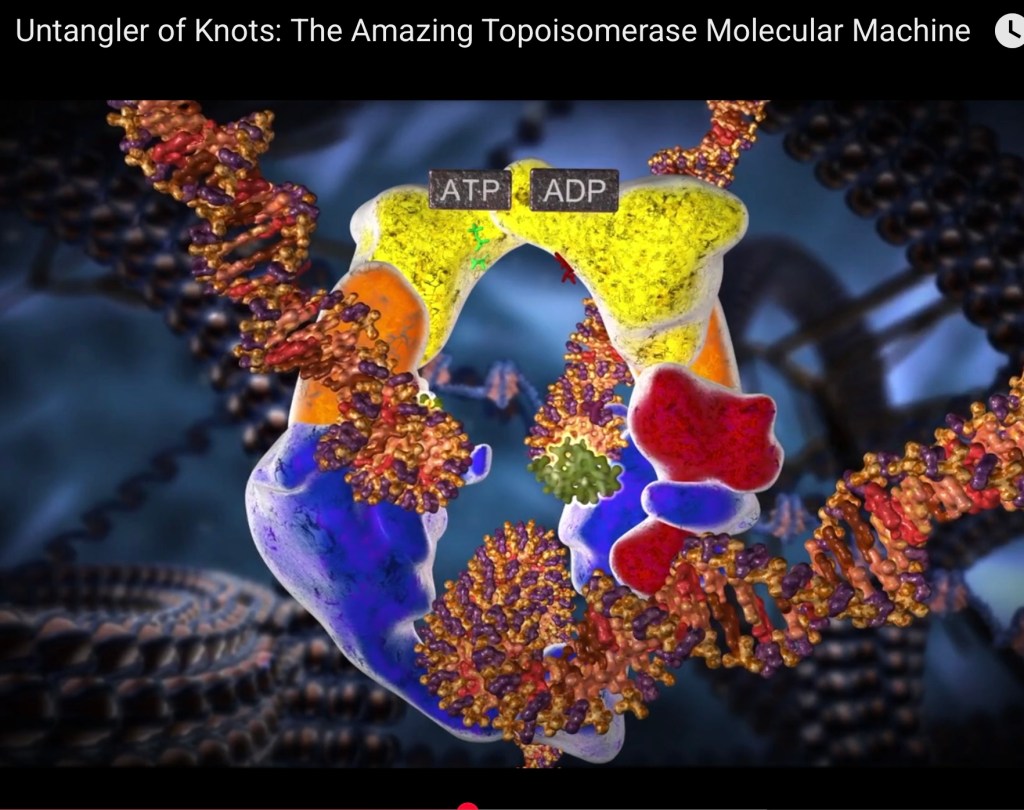
Consider topoisomerase, the enzyme required to manage DNA’s twisting during replication. Without it, DNA strands would become hopelessly tangled, and replication would stall. Yet topoisomerase itself is a protein coded for by DNA. DNA requires topoisomerase; topoisomerase requires DNA. This closed loop cannot arise gradually by chance — it must exist whole and functional from the beginning. The RNA World tries to solve this by suggesting RNA “ribozymes” once performed the role, but this is an imagined solution without a single shred of observational support.
The Religious Nature of the RNA World
At its core, the RNA World is not science but faith in the unseen. It functions as a religious doctrine for naturalism, filling the gap where evidence is missing. Believers in materialism cling to it, not because it has been demonstrated, but because the alternative — an intelligent Creator — is philosophically unacceptable to them.
This is where the irony lies: those who reject faith in God as “unscientific” end up embracing their own faith in something unobserved, untested, and unrepeatable. Both sides involve faith, but only one side rests upon historical testimony, logical coherence, and the observable reality that complex systems always arise from intelligent causes, not chance.
Conclusion: Creation Is the Only Logical Answer
Life is not built upon speculation but upon design. The interlocking systems of DNA, proteins, enzymes like topoisomerase, and the irreducible complexity of replication all point toward an intelligent Creator. The RNA World Hypothesis, lacking evidence, falls not in the category of science but of belief.
Therefore, the conclusion is clear: life did not evolve out of blind chance through an unproven RNA world, but was created fully functional by a wise and intelligent Designer.


Leave a Reply