Human Being or Human Becoming
Many people spend their entire lives trying to discover their purpose. This longing is built into every human heart. We all ask: Why am I here? What is the meaning of life? What is my purpose?
The answer is far greater than most have been told. Your purpose is not simply to be a good person or to make it to heaven one day. Your purpose is union with God—to be transformed, to become like Him by grace, to share in His very life.
This is what the Church calls theosis. It is not an abstract idea, but the very reason you exist. God created you not just to follow Him from a distance, but to dwell in Him and for Him to dwell in you.
Sadly, much of Western Christianity has reduced this great calling. Instead of leading people into transformation and union with God, it often offers moral rules and a distant hope of “getting to heaven.” And so many spend their lives trying to behave well enough, never realizing they were created for something infinitely greater.
But the truth remains:
Your purpose is not just to be good—your purpose is to become like God.
This truth is declared in the very first chapter of the Holy Scriptures, where the Holy author tells us that God created man “in His image and likeness.” From this we see the great love the Triune God has for mankind. As the book Theosis: The True Purpose of Life explains:
“He does not wish him simply to be a being with certain gifts, certain qualities, a certain superiority over the rest of creation. He wishes him to be a god by grace.”
The Orthodox Study Bible helps us understand what this means and what it does not mean. The term theosis may sound foreign—even offensive—to the modern American mind, yet it has always been the very purpose of humanity from the beginning. The Apostles and the early Christians knew this well.
Theosis is nothing less than becoming truly human. You may have heard the saying: “Christ did not come to make bad men good; He came to make dead men live.” Humanity is “dead” because sin has cut us off from God, who is life itself. This is the work of the devil—to sever us from our Father and leave us lifeless. But Christ restores us to life through His One, Holy, Catholic, and Apostolic Church.
Our goal as Christians in not to get to Heaven; our goal is to become real Humans by the Grace of God through His Church.
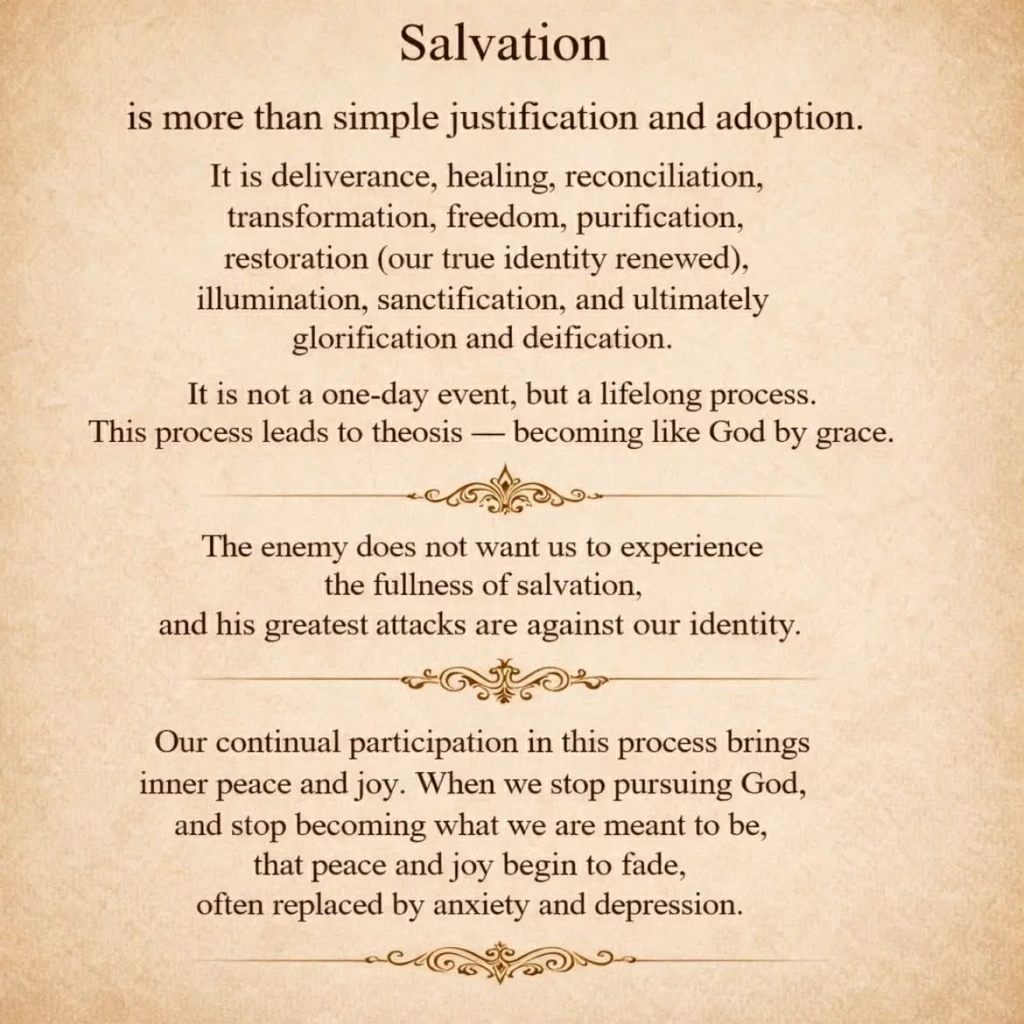
This restoration—what we call salvation—is the work of theosis: becoming human in the fullest sense. When this truth takes root in your soul and becomes the reason you live, then every moment of your life—whether sorrow, joy, pain, or triumph—will have meaning.
Consider the bread of the altar. The dough is mixed, kneaded, pressed, stamped, shaped, and finally placed in the oven until it becomes holy bread. In the same way, our lives, with all their struggles and experiences, are being worked into a holy offering, fit for God.
This reflection from the Orthodox Study Bible on theosis (a term traditionally called “deification”) shows us that our purpose is not merely to exist or become better people, but to become what God has always intended—holy, alive, and fully human in Him.
Theosis is the ancient theological word used to describe the process by which a Christian becomes more like God. St. Peter speaks of this process when he writes, “As His divine power has given to us all things that pertain to life and godliness . . . you may be partakers of the divine nature” (1:3, 4).
What does it mean to partake of the divine nature, and how do we experience this? To give an answer, let us first address what theosis is not, and then describe what it is.
What theosis is not. When the Church calls us to pursue godliness, to be more like God, this does not mean that human beings become divine. We do not become like God in His nature. That would not only be heresy, but it would also be impossible. For we are human, always have been human, and always will be human. We cannot take on the nature of God.
St. John of Damascus makes a remarkable observation. The word “God” in the Scriptures refers not to the divine nature or essence, for that is unknowable. “God” refers rather to the divine energies—the power and grace of God that we can perceive in this world. The Greek word for God, theos, comes from a verb meaning “run,” “see,” or “burn.” These are energy words, so to speak, not essence words.
In John 10:34, Jesus, quoting Psalm 81:6, repeats the passage, “You are gods.” The fact that He was speaking to a group of hypocritical religious leaders who were accusing Him of blasphemy makes the meaning doubly clear: Jesus is not using “god” to refer to divine nature. We are gods in that we bear His image, not His nature.
What theosis is. Theosis means we are to “become” more like God through His grace or divine energies. In creation, humans were made in the image and likeness of God (Gen 1:26) according to human nature. In other words, humanity by nature is an icon or image of deity: the divine image is in all humanity. Through sin, however, this image and likeness of God was marred, and we fell.
When the Son of God assumed our humanity in the womb of the blessed Virgin Mary, the process of our being renewed in God’s image and likeness was begun. Thus, those who are joined to Christ, through faith, in Holy Baptism begin a process of re-creation, being renewed in God’s image and likeness. We become, as St. Peter writes, “partakers of the divine nature” (1:4). We partake of this divine nature in the Holy Church through the sacraments.
Because of the Incarnation of the Son of God, because the fullness of God has inhabited human flesh, being joined to Christ means that it is again possible to experience theosis, the fulfillment of our human destiny. That is, through union with Christ, we become by grace what God is by nature—we “become children of God” (Jn 1:12). His grace—His energy, His godliness—interpenetrates our humanity. “Unless you eat my flesh and drink my blood, you have no part in me” (Jn 6:53). This is no metaphor; it is reality.
Historically, theosis has often been illustrated by the example of a sword in the fire. A steel sword is thrust into a hot fire until the sword takes on a red glow. The energy of the fire interpenetrates the sword. The sword never becomes fire, but it picks up the properties of fire.
By application, the divine energies interpenetrate the human nature of Christ. When we are joined to Christ, our humanity is interpenetrated with the energies of God through Christ’s glorified flesh. Nourished by the Body and Blood of Christ, we partake of the grace of God—His strength, His righteousness, His love—and are enabled to serve Him and glorify Him. Thus we, being human, are being made gods. So, we can think of ourselves not only as human beings, but human becomings.
“For the Son of God became man so we man might become God.” ~ St. Athanasius of Alexandria, On the Incarnation


Leave a Reply